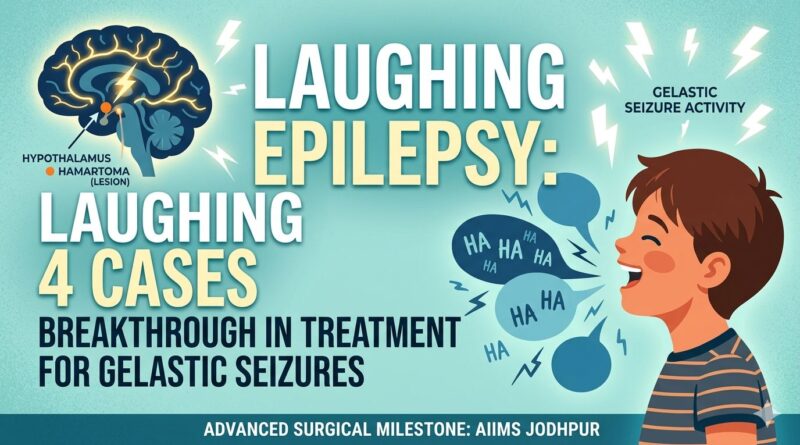
Laughing Epilepsy or Gelastic Epilepsy
Laughing Epilepsy
Imagine a child laughing uncontrollably—not because of a joke or a tickle, but because of a glitch in their brain’s wiring. This is the reality of Gelastic Epilepsy, a rare condition where seizures manifest as sudden, mirthless bursts of energy that look and sound like laughter.
While this condition has long been a mystery to many, a recent medical milestone in April 2026 has brought it into the spotlight. Surgeons at AIIMS Jodhpur successfully treated four children suffering from this exhausting condition, marking a massive leap forward in minimally invasive brain surgery.
The Milestone: 4 Lives Changed at AIIMS Jodhpur
In a recent breakthrough, a team of specialists at the All India Institute of Medical Sciences (AIIMS) Jodhpur successfully performed advanced surgeries on four pediatric patients. Before the intervention, these children were trapped in a cycle of 10 to 20 seizures every single day.
The team used a technique called Stereotactic Radiofrequency Ablation. Instead of traditional open-brain surgery, doctors used:
- Computer-Guided Precision: To locate the tiny lesion deep in the brain.
- Minimal Incisions: A small, one-inch opening to reach the target.
- Ablation: Using thermal energy to “switch off” the specific area causing the seizures.
All four patients were discharged within 48 hours and, most importantly, are now seizure-free.
Understanding the “Why”: Hypothalamic Hamartoma
In almost all these cases, the “laugh” is triggered by a Hypothalamic Hamartoma (HH).
- What is it? A non-cancerous, tumor-like growth that forms in the hypothalamus (the part of the brain that regulates emotions and hormones) before birth.
- The “Gelastic” Trigger: Unlike other forms of epilepsy that might cause shaking, HH triggers the brain’s “laughing circuit.”
- The Toll: Because the laughter is “hollow” and mechanical, it is often mistaken for a behavioral quirk in toddlers, leading to years of delayed diagnosis.
The 4 Stages of the Condition
Recent clinical reports, including those from the AIIMS cases, highlight a common progression in patients:
| Stage | Manifestation |
|---|---|
| Infancy | Short, frequent “giggling” spells, often dismissed as colic or normal baby behavior. |
| Childhood | The laughter becomes more “hollow” and can be followed by “Dacrystic” seizures (uncontrollable crying). |
| Developmental | If left untreated, the constant electrical “storms” can lead to cognitive decline or “rage attacks.” |
| Hormonal | Many patients experience Precocious Puberty because the growth sits on the brain’s hormone center. |
Why This Matters Now
For a long time, Gelastic Epilepsy was considered “drug-resistant.” Standard anti-seizure medications rarely work on these deep-seated lesions. The success of these four recent cases proves that early surgical intervention—specifically minimally invasive ones—can halt the progression of the disease before it affects a child’s learning and development.
A Note for Parents: If a child has repetitive, out-of-place laughing fits that seem “forced” or are followed by a look of confusion or fatigue, it’s worth consulting a pediatric neurologist. It might not be a “mood”—it might be a signal.